
The Approach
The staged journey from silos to systems.
A rocket doesn't go up in one motion. It moves through stages — each one designed for the conditions of the next. That's how enterprise AI transformation actually works. We named our three stages after what they do.
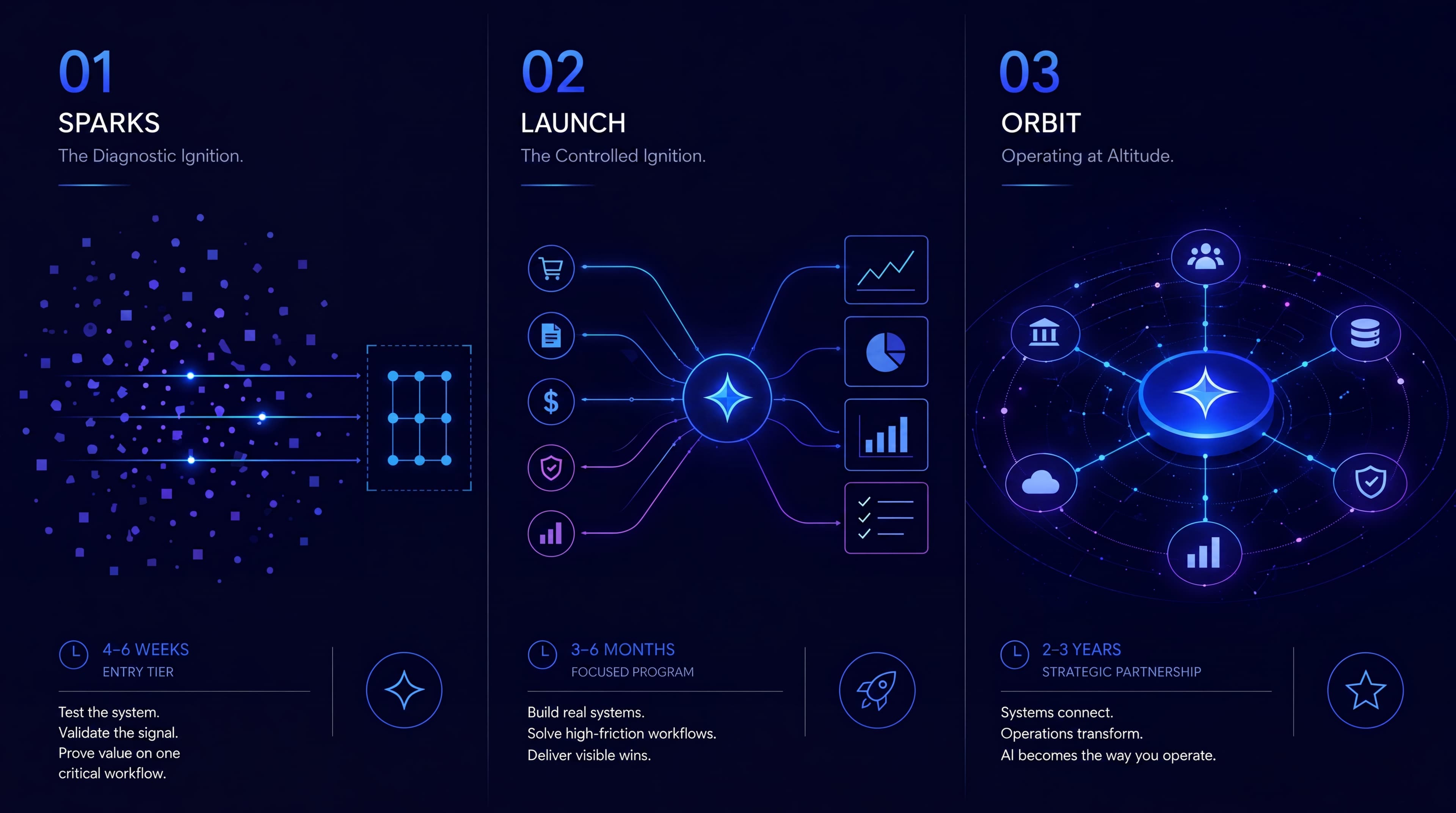
4–6 weeks · Entry tier
Sparks — The Diagnostic Ignition.
- Test the system.
- Validate the signal.
- Prove value on one critical workflow.
Sparks is a paid diagnostic engagement that tests whether your organization is ready for more. We run small, controlled experiments inside the client — a targeted proof-of-concept on one painful workflow, a data readiness assessment, a governance gap analysis, a stakeholder alignment check.
Sparks is how we earn the right to recommend more — and how we say "not yet" when we need to. Our credibility is built on being the partner who sometimes says "not yet."
What you walk away with
- One working AI proof — in production, on a real workflow, showing measurable value.
- An honest readiness diagnosis — is Launch advisable now, or not yet?
- A concrete Launch roadmap — if we recommend proceeding.
3–6 months · Focused program
Launch — The Controlled Ignition.
- Build real systems.
- Solve high-friction workflows.
- Deliver visible wins.
Launch is a focused engagement where we build the real systems. We identify the highest-friction workflows, ship targeted operational systems that solve them, and deploy those systems into production. Clients see visible wins within weeks, not years.
Typical scope includes procurement intelligence, financial reconciliation, budget allocation, compliance automation, cross-departmental reporting — whatever the organization's highest-friction point is.
What you walk away with
- Working systems in production, owned by your team.
- Measurable ROI on the initial investment.
- A team that believes the direction is right — and is ready for what comes next.
2–3 years · Strategic partnership
Orbit — Operating at Altitude.
- Systems connect.
- Operations transform.
- AI becomes the way you operate.
Orbit is a multi-year transformation program where the wins connect into a system, and the system reshapes how the organization operates. Departments start sharing data. Governance matures. AI moves from projects into operating rhythm.
Once the organization reaches orbit, something changes. From that altitude, leadership can see everything. Decisions get clearer because the full picture is finally visible. The organization moves with less friction — because it's no longer fighting gravity. It's operating above it.
What you walk away with
- An AI-native enterprise — not an enterprise that uses AI, but one that operates as one.
- Mature governance, data infrastructure, and operational rhythm.
- A team that runs the system without us in the loop.
Qualification discipline
We refuse engagements where the conditions for success don't exist.
Saying no is a strategic asset. Every prospect is evaluated against six hard barriers. If two or more are weak, we decline or scope a Phase 0 governance engagement before anything else.
Executive sponsor with real authority.
Not a champion in the middle, but a leader who can make decisions stick.
Top-down mandate.
Leadership has publicly committed to the initiative.
Cultural readiness.
The organization rewards experimentation rather than punishing failure.
Internal team alignment.
The in-house team is positioned as partner, not gatekeeper.
Governance in place — or willingness to build it.
If governance is weak, we scope a Phase 0 engagement before anything else.
Budget aligned to the chosen tier.
Sparks/Launch budget buys Sparks/Launch. Orbit budget buys Orbit. Mismatches get redirected, not force-fit.
Who Ayvo isn't for.
The wrong client for Ayvo is an enterprise that:
- Wants to use AI but has no top-down force driving it.
- Lacks the cultural readiness to change how work gets done.
- Has an internal team convinced they can do everything alone.
- Has no allocated budget and is looking for free consulting dressed as a pilot.
- Wants a deck, not a system.
- Wants a tool, not a transformation.
We don't try to convince these organizations otherwise. We point them to other providers or suggest they return when conditions change.
If you've read this far, the next step is short.
Thirty minutes with one of our principals. We'll tell you whether Sparks is the right fit — or whether it isn't.